How to calculate overtime on biweekly and semi-monthly pay
Is overtime calculated weekly or biweekly?
Weekly. The FLSA defines a workweek as a fixed, regularly recurring period of 168 hours, that is seven consecutive 24-hour periods. It can start on any day and at any hour, but once set it should stay the same.
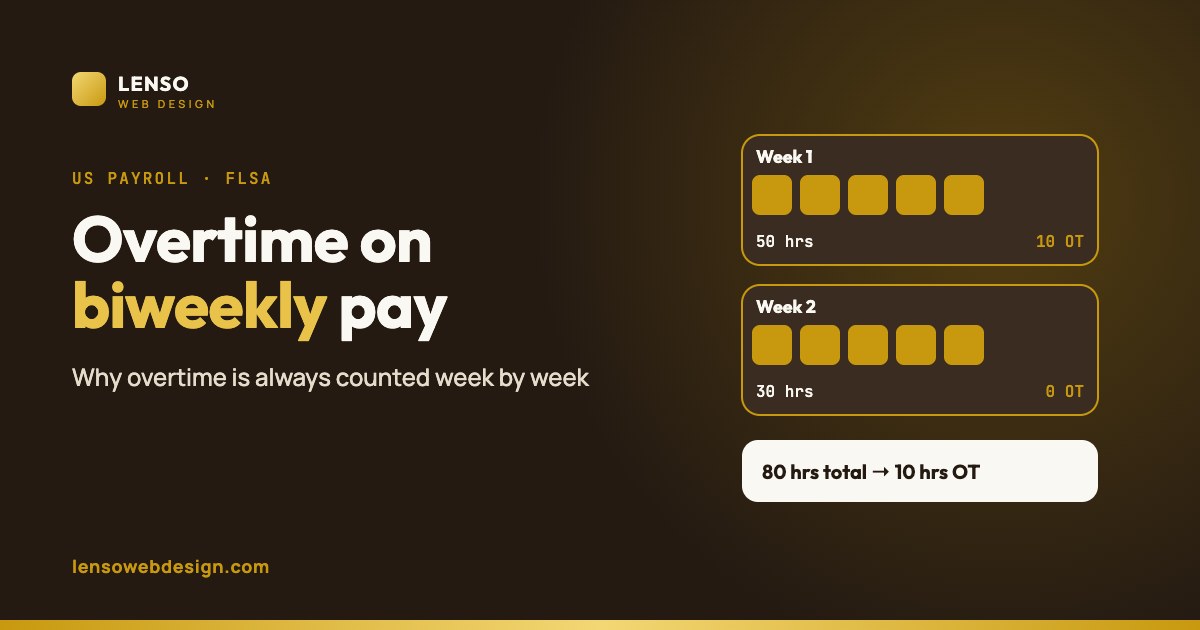
Each workweek is looked at on its own. You can't average hours across two weeks, even if you pay every two weeks. A 50-hour week followed by a 30-hour week still has 10 hours of overtime, even though the two weeks add up to 80.
The basic formula for each workweek:
- Regular hours = hours worked, up to 40
- Overtime hours = hours worked over 40
- Pay = (regular hours × rate) + (overtime hours × rate × 1.5)
The "rate" here is the employee's regular rate. For most hourly staff it's the hourly wage, but it usually also has to include non-discretionary bonuses and some other payments. The Department of Labor's Fact Sheet 56A covers what counts.
Our free time card calculator applies the weekly rule automatically for weekly, biweekly, semi-monthly and monthly periods, with lunch breaks, PTO and California-style daily overtime.
Open the time card calculator →How to calculate overtime on a biweekly pay period
Example 1: two uneven weeks
An hourly employee earns $20/hour and works 46 hours in week 1 and 34 hours in week 2.
| Week | Hours | Regular | Overtime | Pay |
|---|---|---|---|---|
| Week 1 | 46 | 40 | 6 | $980.00 |
| Week 2 | 34 | 34 | 0 | $680.00 |
| Pay period | 80 | 74 | 6 | $1,660.00 |
Week 1: 40 × $20 = $800, plus 6 × $30 = $180, so $980. Week 2: 34 × $20 = $680.
The averaging mistake: treating 80 hours as "two normal weeks" pays 80 × $20 = $1,600. That's $60 short, because the 6 overtime hours in week 1 were paid at straight time.
How to calculate overtime on a semi-monthly pay period
Semi-monthly payroll (for example the 1st–15th and 16th–end of the month) doesn't line up with workweeks. Most periods start or end mid-week, so one workweek gets split across two paychecks. The rule doesn't change: total the hours for the whole workweek, even the days that fall in the other pay period.
Example 2: a workweek split across two periods
The workweek runs Sunday to Saturday. The pay period is October 1–15, 2026, and October 1 is a Thursday. The employee earns $22/hour.
- Monday–Wednesday, Sept 28–30 (paid in the previous period): 24 hours
- Thursday–Saturday, Oct 1–3 (this period): 8 + 8 + 6 = 22 hours
- Workweek total: 24 + 22 = 46 hours, so 6 hours of overtime
The first 24 hours were already paid at the regular rate last period. In this period, the 22 hours split into 16 regular hours (to reach 40) and 6 overtime hours.
Pay for Oct 1–3: 16 × $22 = $352, plus 6 × $33 = $198, so $550. If you only looked at the 22 hours inside this period, you'd pay no overtime at all and underpay by $66.
In our calculator, enter the 24 earlier hours under "Hours already worked in this period's first workweek" in the advanced settings. It then splits regular and overtime hours correctly.
Does PTO or holiday pay count toward overtime?
Under the FLSA, no. Pay for hours that aren't worked, such as vacation, PTO, holidays and sick leave, isn't counted as hours worked. So it doesn't count toward the 40-hour overtime threshold. You pay it at the regular rate on top.
Example 3: a holiday week
$20/hour. The employee works 42 hours and also gets 8 hours of holiday pay.
| Item | Hours | Rate | Pay |
|---|---|---|---|
| Regular (worked) | 40 | $20.00 | $800.00 |
| Overtime (worked) | 2 | $30.00 | $60.00 |
| Holiday pay | 8 | $20.00 | $160.00 |
| Total | 50 | $1,020.00 |
Overtime is 2 hours, not 10, because the 8 holiday hours weren't worked. Some employers choose to count paid leave toward overtime as a benefit, and some union contracts or states require it, so check your own policy.
How to calculate hours worked with a lunch break
Under federal guidance, short rest breaks of about 5–20 minutes count as paid work time. A bona fide meal period, usually 30 minutes or more where the employee is fully relieved of duty, doesn't have to be paid. Subtract only unpaid meal time.
Example 4: clocking out for lunch (a split shift)
Clock in 8:52 AM, out for lunch 12:05 PM, back 12:35 PM, clock out 5:07 PM.
- Morning: 8:52 → 12:05 = 3 hours 13 minutes
- Afternoon: 12:35 → 5:07 = 4 hours 32 minutes
- Total: 7 hours 45 minutes = 7.75 hours (45 ÷ 60 = 0.75)
To convert minutes to decimal hours for payroll, divide by 60: 15 min = 0.25, 30 min = 0.5, 45 min = 0.75. In our calculator, tap + Shift to log the second clock-in and clock-out, so the lunch gap is left out automatically.
Rounding: Many time clocks round punches to the nearest 5, 6 or 15 minutes. That's allowed only if it's neutral over time. It must not always round in the employer's favour.
California daily overtime (and double time)
Some states add daily rules on top of the federal weekly rule. California is the best known. In general it requires:
- 1.5× the regular rate for hours over 8 in a workday, over 40 in a workweek, and the first 8 hours on the seventh consecutive workday in a workweek
- 2× the regular rate for hours over 12 in a workday and over 8 on the seventh consecutive workday
Example 5: one long day
$20/hour. Monday 10 hours, Tuesday–Thursday 8 hours each, Friday 6 hours: 40 hours in total.
- Federal rule only: 40 hours = no overtime = $800
- California: Monday has 2 hours of daily overtime, so 38 regular + 2 overtime = 38 × $20 + 2 × $30 = $820
A 13-hour day in California is 8 regular + 4 overtime + 1 double-time hour. Hours already paid as daily overtime aren't counted again toward the weekly 40. California has many exceptions, including alternative workweek schedules and some industries, so confirm your rules with the state.
Add each employee, switch on daily overtime and double time, log PTO and split shifts, then export a CSV for payroll. Free, no login, and your data stays in your browser.
Use the free calculator →Common overtime mistakes on biweekly and semi-monthly payroll
- Averaging two weeks. Overtime is per workweek. 50 + 30 hours still means 10 hours of overtime.
- Ignoring split workweeks. On semi-monthly payroll, hours from the previous period still count toward that workweek's 40.
- Counting PTO as worked time when your policy doesn't. It inflates overtime, and the reverse mistake underpays it.
- Deducting short breaks. Rest breaks of about 5–20 minutes are generally paid.
- Leaving bonuses out of the regular rate. Non-discretionary bonuses usually raise the overtime rate.
- Changing the workweek start day to avoid overtime. The workweek must be fixed.
Frequently asked questions
Is overtime calculated weekly or biweekly?
Weekly. Each FLSA workweek stands alone, so you can't average hours across a two-week pay period.
Does PTO count toward overtime?
Not under federal rules. PTO, holidays and sick pay aren't hours worked. Some employers and states count them anyway, so check your policy.
How do you calculate overtime on a semi-monthly pay period?
Work it out per workweek. When a week is split between two periods, add the hours from both sides to find the weekly total, then pay the overtime for that week.
Is a lunch break counted as hours worked?
Short rest breaks (about 5–20 minutes) are paid. A bona fide meal period of usually 30 minutes or more, fully relieved of duty, doesn't have to be.
How does California daily overtime work?
Generally 1.5× over 8 hours a day or 40 a week, 2× over 12 hours a day, plus special seventh-day rules. There are exceptions.
Sources
- US DOL: Fact Sheet #23, Overtime Pay Requirements of the FLSA
- US DOL: Fact Sheet #56A, Regular Rate of Pay
- 29 CFR 778.218, Pay for certain idle hours
- US DOL: Handy Reference Guide to the FLSA
- California DIR: Overtime FAQ
This guide is general information, not legal or tax advice. Overtime rules depend on the employee's classification, industry and state. Check the US Department of Labor and your state labor office, or ask a payroll professional, before running payroll.